

Siberian Wind (Home Again)
Guest contributor Archie Cornish describes how growing up in the windswept East Anglian fens sparked an enduring fascination with the distant landscapes of Siberia

This piece was submitted in response to our latest creative prompt—an open invitation to our readers to create and reflect. You can find the full prompt and details on how to join in here.
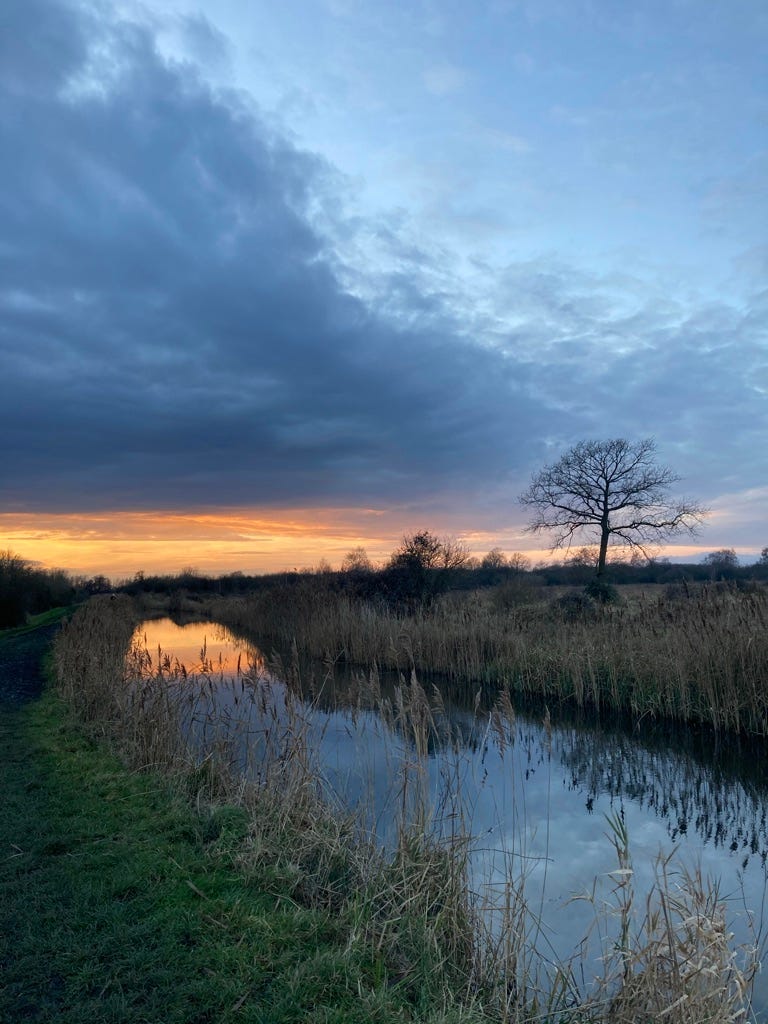
The outskirts of a university town in the east of England: that’s where I grew up, but I was packed off to boarding school at thirteen, and I’ve been hankeringly fascinated with my home territory ever since.
It’s always colder in our childhoods, but my early winters really were cold—I have statistical proof, or at least a memory of it. Our silver Volkswagen had an inbuilt thermometer; picking me up by the playing fields, one December afternoon after football, my mum turned the ignition and exclaimed, “Minus five”, vowels chiming in amazement. The coldest air came from east winds, blowing in from the North Sea, racing across the vast, hedgeless grid of the drained fens. On the coast this easterly chill is known as the “ghost wind”. In my home town it was given another origin, less fanciful, uttered with absolute confidence by the geography teachers and shopkeepers and football coaches who told us it came straight from Siberia.
We didn’t consider ourselves remote—London was an hour away by train—but the land to the northeast possessed an understated desolation, and some of this wildness crept into the stories we’d tell about our homeland. Looking back, this common knowledge has the character of repressed folklore, superstition squeezed through the filter of rationality. In winters gone by, elders would tell us, the rivers and ditches froze and folk would travel huge distances on fen skates. The fens themselves were supposed to be the holdout of “fen tigers”, a kind of wildcat. Every so often there was a sighting, and once a tiger wandered off the fens into the city. Games were called off for a few days, for fear of the tiger skulking on the playing fields, and the headmaster warned us against walking unaccompanied.
Did that happen? It seems incredible, but in my memory it has all the prosaic matter-of-factness of “minus five”.
Of these semi-superstitions the Siberian wind commanded the most respect. It has a scientific ring, probably because it contains a grain of truth. Bone-dry, bitterly cold air does drift from Eurasia towards western Europe in winter. Meteorologists call it the Siberian High, a seasonal mass collecting above the boreal forest, colder than the Arctic air to the north warmed by ice-radiated heat. What seems absurd, though, is the standard explanation for our unique exposure. Nothing but flat defenceless land, we’d hear, divided us from Siberia—as if between Lake Baikal and the eastern counties of England there was only fen, steppe and prairie. Adults declared this with total authority, skimming over the small matter of the Ural and Carpathian and Alpine mountain ranges.
Strangers often bring up the Siberian Wind when I mention coming from the east. It’s found its way into fiction: J.L. Carr’s football fairytale, How Steeple Sinderby Wanderers Won the FA Cup, describes the exploits of an invented team on real Fenland ground, playing midwinter matches in a climate both “typically English” and otherworldly, as “biting winds blow in from the USSR”.
It features too in alumni reminiscences, tales of undergraduate triumph and disaster on wind-whipped fields and shiveringly draughty rooms. For visitors passing through our town, the Siberian Wind is part of what makes it picturesque: a world unto itself, an initiation rite at once hedonistically carefree and formatively austere. My parents came as students but ended up staying, my mum as a doctor and my dad to teach at the university. I experienced my hometown not as a three-year zoned-off bubble, but as the centre of my world, capital of the quietly beautiful land sprawling all around. Working its way into my imagination, the wind made me wonder where I really came from and, before long, had me dreaming of Siberia.
*
For my thirteenth birthday, the last before I left, my mum bought me some grown-up books. Solzhenitsyn’s One Day in the Life of Ivan Denisovich revealed the gulag—Siberia refashioned after Stalin’s design, as a giant penal colony for Soviet dissidents. I remember Ivan sharing his extra bowl of oatmeal with Kilgas, his co-prisoner, who keeps spirits up with good jokes. Solzhenitsyn calls Kilgas a “Lett”, which I worked out meant “Latvian”. I found Latvia on my atlas, looked across the great Russian landmass to Siberia, and imagined Kilgas looking in the other direction, back towards a home he had scant hope of seeing again.
I knew that Siberia lay beyond the Urals, but about its exact borders I was unclear. Maps of many kinds, I noticed, struggled to represent a place so extreme. In the atlas Russia sprawled, bloated to gigantic size by the Mercator projection, east to west across a double-page spread. But on the globe it stretched up and away, making the journey into Siberia a northward as well as eastward move.
Years later, researching premodern Siberia—the gaps between the islands of Solzhenitsyn’s gulag archipelago—I discovered that the Russians shared my confusion: they’d never known precisely where, or even what, Siberia was either. The name comes from the Khanate of Sibir, a Tatar polity conquered by fur-trading Cossack adventurers in the sixteenth century. It would take the Russian Empire two centuries to subdue the rest of northeastern Eurasia. Settlers arrived, intermarrying with indigenous people; convicts joined them. The Russian writer Vladimir Korolenko, exiled to Yakutia in the 1880s, made extensive study of Yakuts culture. Local folksong, Korolenko thought, preserved in its strange guttural rasp the sound of the Siberian wind in the mountain gorges.
On the far side of my hometown, in a museum dedicated to polar science and exploration, I saw a knife—thin fixed blade, round handle of grooved bone—in a glass case. The explorer Frederick George Jackson had brought it home in the 1890s from his travels among the Nenets people of the far Russian north. The bone was reindeer, I read, but to me the Nenets knife seemed of a piece with another collection, this one on our side of town—the Folk Museum, whose displays we were invited to reach out and touch: wrought-iron toasting forks, thatch-cutters, votive chimney dolls; and fen skates, standing upright on rusted runners, all stiff leather and desiccated laces.
These nineteenth-century relics of my home region seemed remote but at the same time familiar. But so did Jackson’s keepsake. Like East Anglians, the Nenets (or Samoyeds, as Jackson called them) live on flat open land. “The Samoyed,” comments the Australian editor of Jackson’s travelogue, The Great Frozen Land (1895), “is the fen-man of that Arctic belt that stretches from near Mezen even to the valley of the Lena”—across, that is, the whole of Siberia.
*
At boarding school I missed home, but had fun playing football and studying the Russian Revolution. I grew up and left for university, where I started to encounter the wider world. Did I know, asked a friend from Edinburgh, that the Scottish capital lies further west than Bristol? What I had to realise, explained the American on our corridor, was that New York City shares a latitude with Madrid. Geographical revelations like these had something of hard plain truth to them, the adult equivalent of finding out about Father Christmas.
Part of belonging to a place is not knowing where it really is: a kind of ignorance as to the co-ordinates of home on the map of context. I have resisted, until this point, calling my hometown Cambridge, because its famous name summons a host of associations that smear its childhood reality. People imagine the university as a rarefied idyll, a pastoral theme park of punting and unwalkable grass, tinged by its long entanglement with the British establishment. For a while I’d respond by dividing this idyll from my Cambridge, the colder and dreamier outskirts where the fenland desolation began. But I’ve come to see that the university itself was full of strangeness and dreaming, the austerity and intensity of intellectual inquiry. My dad’s graduate students sometimes cycled to our house for supervisions. They’d sit in his study for hours, discussing international relations, until the sun set over the fields behind our house.
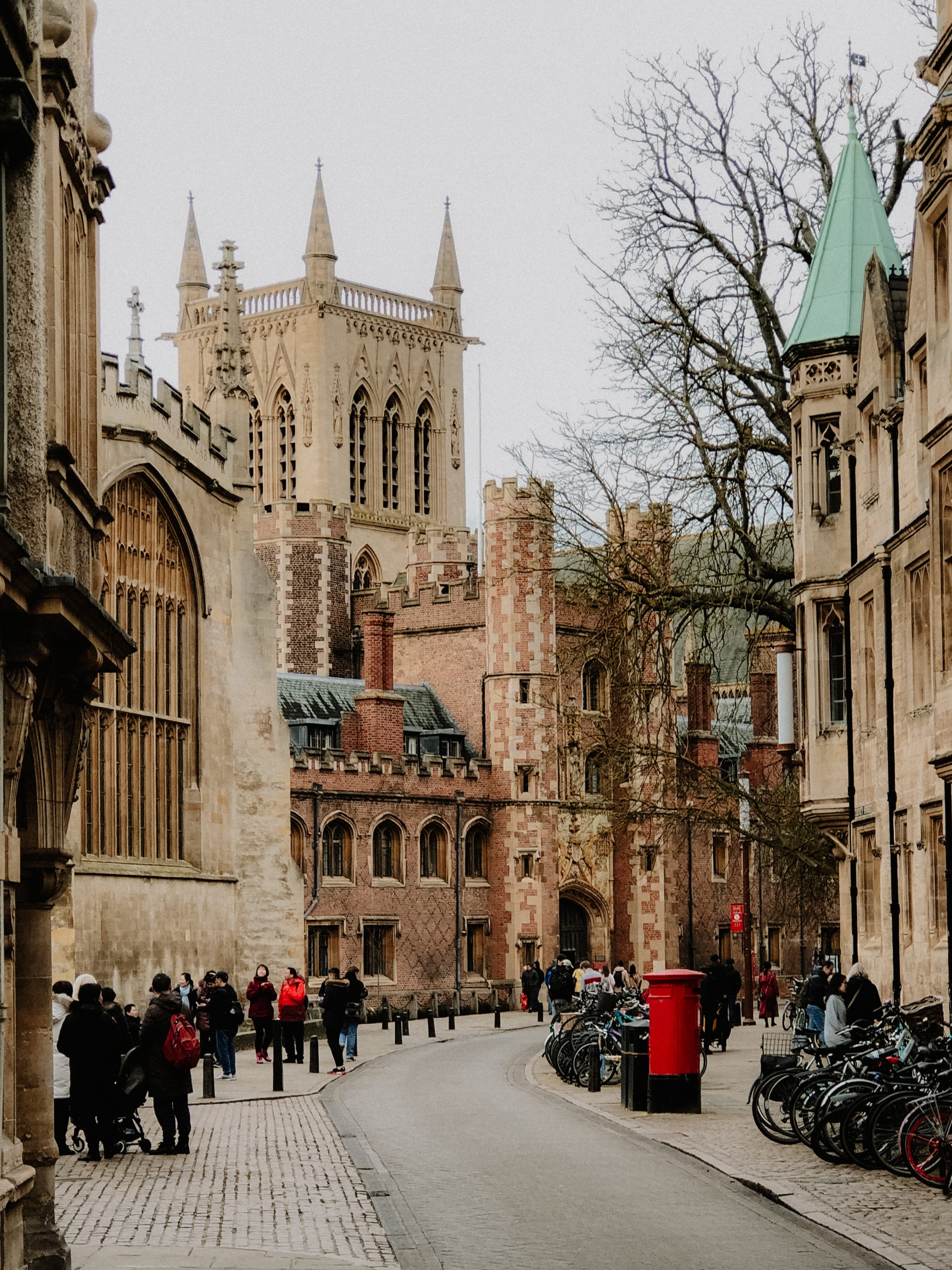
One student came from east of the Urals. In a very early memory I stand in the garden, looking up at this twentysomething man, and ask whether he knows that Russia is the biggest country in the world. His Turkic features crease as he laughs in delight. I always wanted to travel to the Russian Far East, but those plans are in hibernation now, ever since Russia resumed its wars of conquest. Siberia, origin of my childhood preoccupations with the suppressed remoteness of my homeland, has become doubly inaccessible: the remote Eurasian interior of a country which, choosing hostility with Europe, has closed itself off. Visiting home, though, I find traces of those northeastern dreams: in midwinter sunlight, oblique but piercing in the huge unobstructed eastern sky, making true gold of the bare branches; and then, as the branches stir, in the easterly gust of Siberian wind, cold and salutary.
 | A guest post by
|
This is beautiful. I too was preoccupied with Siberia growing up, only I grew up in Sweden in the shadow of the Soviet Union, u-boats slipping away in the Baltic sea. I ended up studying Russian at university and spending a year abroad there 1998-1999. I am sad now that the country is closed off to us, although the wind will continue to sweep across Sweden fron Siberia and all the way to the Fenland. 🙏🏼
thanks for this Archie!